
Breakthrough in High-Power 1060 nm SLD Chips
A major laser manufacturer in mainland China has recently announced the successful development of a high-power 1060 nm SLD chip. According to the reported test results, several key performance indicators have reached the level of comparable international products, marking important progress in the domestic development of broadband semiconductor light sources.
The 1060 nm SLD chip is particularly suitable for use as a seed source in fiber laser systems. Unlike conventional narrow-linewidth laser diodes, an SLD combines relatively high output power with a broad optical spectrum. When injected into a fiber amplifier, this broadband operating characteristic can help suppress stimulated Brillouin scattering, commonly known as SBS, during the amplification process. SBS is one of the main nonlinear effects limiting the peak output power of high-power and pulsed fiber laser systems.
By reducing the impact of SBS, broadband 1060 nm SLD seed sources can support higher system power and improved operational stability. This makes them highly relevant to precision manufacturing, scientific research, industrial inspection, advanced sensing and other applications requiring reliable high-power fiber laser platforms.
High-performance SLD chips in this wavelength range have traditionally depended heavily on overseas suppliers. Their development involves several demanding semiconductor processes, including high-quality epitaxial material growth, waveguide structure and bending-angle optimization, cavity design and precise facet coating. These technical barriers have made it difficult for local manufacturers to establish a stable supply of high-power broadband SLD devices.
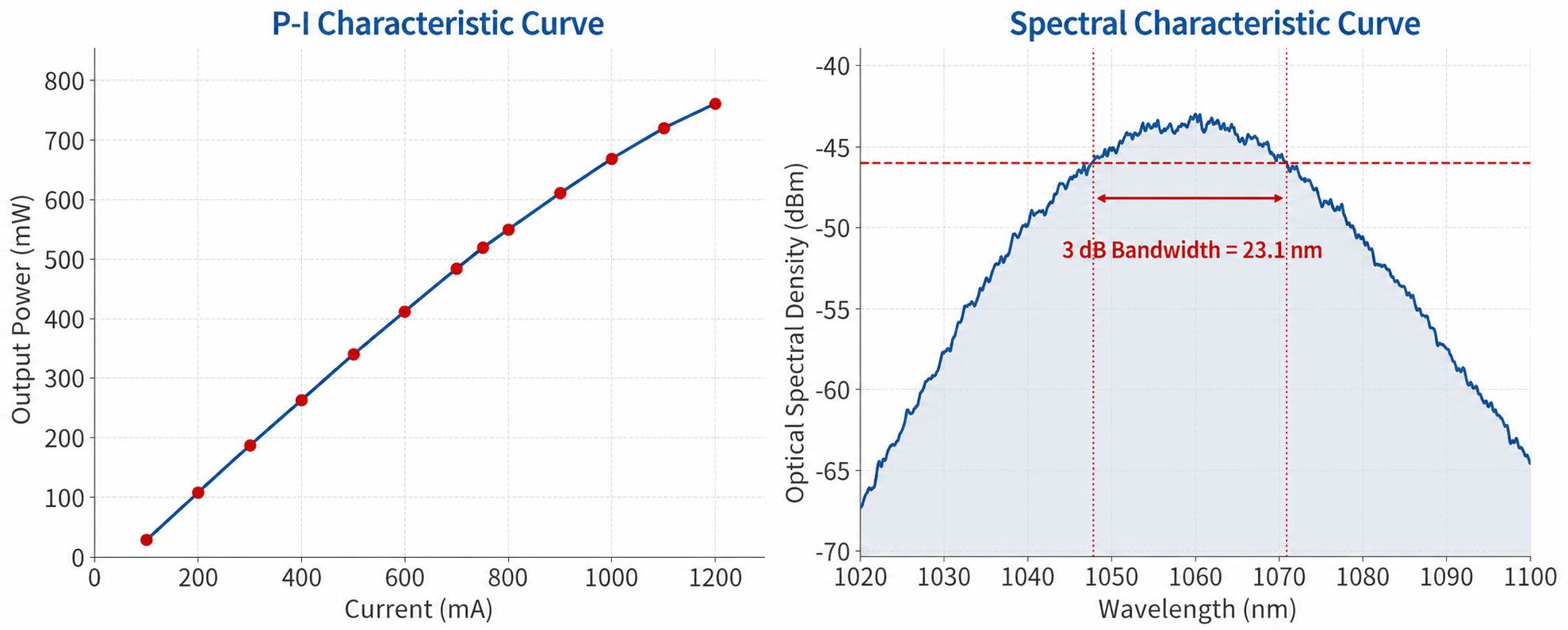
The newly developed chip is reported to deliver more than 700 mW of output power under continuous-wave operation. Its measured 3 dB spectral bandwidth exceeds 20 nm, with test data showing a bandwidth of approximately 23.1 nm. This is considerably broader than the approximately 10 nm bandwidth commonly found in some comparable international products, providing a stronger technical advantage for SBS suppression in fiber laser amplification systems.
The successful development of this 1060 nm SLD chip represents an important step toward reducing dependence on imported core components. It may provide domestic pulsed fiber laser manufacturers with a more stable and reliable source of broadband seed chips, while also strengthening the independent development and supply-chain security of high-end laser equipment in China.


Sign up for our newsletter
Sign up for our newsletter*
