
High-Temperature VCSELs for Atomic Sensors – Part 2
VCSELs near 795 nm and 894.6 nm are used in quantum sensing applications such as CPT atomic clocks and atomic magnetometers. Beyond wavelength and output power, long-term reliability, packaging, and system compatibility are also important for practical integration.
In Part 1, we discussed key optical performance requirements. Our development work addresses four main areas, with this article covering the final two: reliability and packaging, and application-specific customization.
Long-Term Reliability and Packaging
For laboratory prototypes and integrated systems, long-term reliability is essential. Under elevated-temperature conditions, aging tests monitor key parameters such as output power and center wavelength over time. Results involving aging duration, sample size, failure criteria, and allowable parameter drift help assess reliability under defined operating conditions.
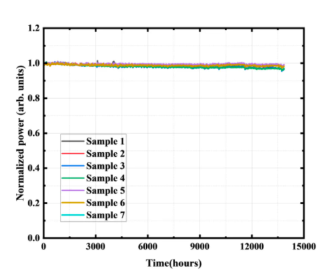
Stable light sources can reduce troubleshooting and maintenance caused by performance drift or device failure, allowing development teams to focus on core system components such as atomic vapor cells, magnetic shielding, and signal processing.
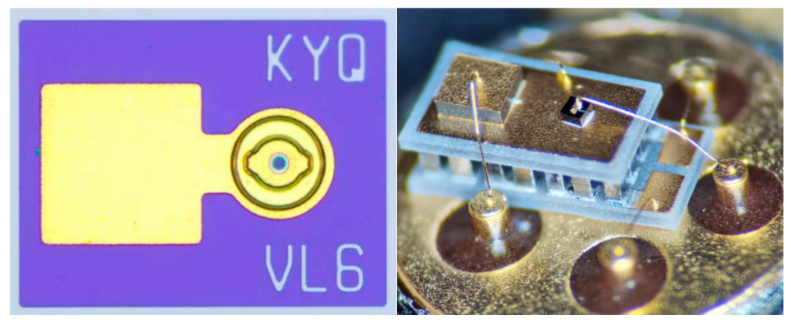
Three package options are available: bare die, TO-46, and low-magnetic packaging. Bare die offers flexibility for teams with in-house packaging and integration capabilities, while TO-46 simplifies assembly, electrical connection, and optical coupling. For applications sensitive to stray magnetic fields, such as SERF atomic magnetometers, low-magnetic packaging can help reduce magnetic interference.
Application-Specific Customization
Selecting a VCSEL requires more than comparing individual specifications. Atomic vapor cells, magnetic shielding, temperature control, frequency locking, and optical modulation can differ between systems, affecting device compatibility.
For CPT atomic clock and atomic magnetometer development, sample evaluation and integration testing can be supported based on target performance, operating temperature, vapor cell type, and optical configuration. Custom development is also available for specific wavelengths, package formats, and magnetic requirements.
By combining reliability evaluation, flexible packaging, and application-specific development, high-temperature VCSELs can support the development of atomic clocks, atomic magnetometers, and other precision sensing systems.
Explore Our VCSEL Products
Visit our VCSEL product page to explore available devices and specifications. For product inquiries or application discussions, contact us at info@tulinopto.com.


Sign up for our newsletter
Sign up for our newsletter*
