
High-Temperature VCSELs for Atomic Sensors – Part 1
VCSELs for Precision Atomic Sensing
In quantum precision measurement systems, the optical source plays a critical role in system performance and long-term reliability. For coherent population trapping (CPT) atomic clocks and atomic magnetometers, key laser parameters—including wavelength, linewidth, side-mode suppression ratio, polarization characteristics, and output power stability—affect atomic excitation, signal quality, and frequency stability. As these systems evolve toward smaller size, lower power consumption, and greater practical integration, light sources must combine high-temperature operation with narrow linewidth, spectral purity, and stable polarization.
To address these requirements, we have focused on four key aspects in the development of our VCSEL products.
This article, Part 1, covers wavelength matching and high-temperature optical performance.
1. Wavelength Matching, Output Power, and Threshold Current
The 795 nm and 894.6 nm wavelength bands correspond to the D1 transitions of rubidium and cesium atoms, respectively. These wavelengths are widely used in CPT atomic clocks, spin-exchange relaxation-free (SERF) atomic magnetometers, and other quantum sensing systems.
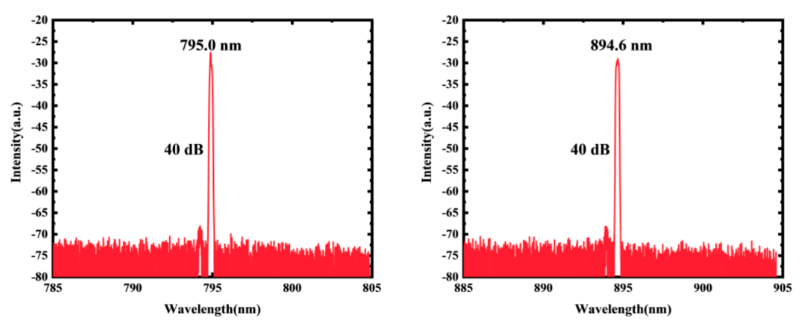
Our VCSEL products offer center wavelengths of 795 ± 0.5 nm and 894.6 ± 0.5 nm, providing a basis for fine wavelength tuning through temperature and drive-current adjustment, as well as atomic spectral-line locking. This helps simplify optical frequency tuning and frequency-locking design at the system level.
For output power, the 795 nm VCSEL delivers at least 0.1 mW, while the 894.6 nm VCSEL delivers at least 0.2 mW. These output levels support optical pumping and atomic signal detection in compact vapor-cell systems. The required incident optical power can be adjusted according to vapor-cell dimensions, beam size, buffer-gas conditions, and optical coupling efficiency. This allows system designers to balance signal strength against effects such as light shifts and power broadening.
Low threshold current is another important consideration for compact, low-power systems. The threshold current is no more than 0.75 mA for the 795 nm VCSEL and 0.70 mA for the 894.6 nm VCSEL. These low threshold levels help reduce the current required to initiate lasing and support power-efficient system design, potentially simplifying the laser driver and thermal-control requirements.
2. High-Temperature Operation, Narrow Linewidth, and Spectral Purity
High-temperature operation is a key feature of this VCSEL series. The devices are designed for operating temperatures in the 70°C–90°C range, supporting integration into atomic vapor-cell systems that require elevated-temperature operation. To limit wavelength variation with temperature, the wavelength temperature coefficient is no more than 0.06 nm/°C. This helps reduce the impact of temperature fluctuations on resonance conditions and supports stable atomic signals under changing thermal conditions.
The VCSEL linewidth is no more than 100 MHz, helping limit the influence of laser spectral width on atomic excitation and detection. Actual system stability also depends on factors such as buffer-gas conditions, optical power, modulation scheme, and feedback-control design.
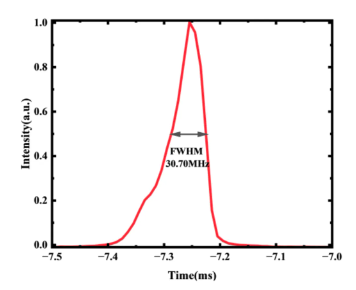
The side-mode suppression ratio (SMSR) is at least 30 dB, reducing unwanted side modes and helping maintain spectral purity. The orthogonal polarization suppression ratio is at least 16 dB, supporting stable linear polarization for coherent population trapping and atomic spin polarization.
In addition, the beam divergence angle (1/e²) is no more than 20°, facilitating optical coupling with collimation and beam-splitting components. This can simplify optical layout and alignment, helping reduce development time for system integration.
Explore Our VCSEL Products
Visit our VCSEL product page to explore available devices and specifications. For product inquiries or application discussions, contact us at info@tulinopto.com.


Sign up for our newsletter
Sign up for our newsletter*
